
Competent Authority Pathway


This is a FAQ BLOG and you can refer to our Getting Started as a General Practitioner in Australia blog here.
Need help understanding your pathway?
Date Updated: 2026-02-03
What is the Competent Authority Pathway?
The Competent Authority Pathway is one of 3 ways an International Medical Graduate (IMG) can become a General Practitioner in Australia, and it is open to IMGs who have worked in a country recognised as competent by the Medical Board of Australia and have been assessed by a competent authority.
Authorities recognised as competent:
- General Medical Council (GMC) United Kingdom (UK) with PLAB test and graduates of GMC-accredited medical courses
- Medical Council of Ireland (MCI) and graduates of MCI-accredited medical courses
- Medical Council of Canada (MCC) with LMCC
- Medical Council of New Zealand (MCNZ) with NZREX
- Educational Commission for Foreign Medical Graduates of the United States (ECFMG) USA with USMLE or NBME
- National Board of Osteopathic Medical Examiners (NBOME) with COMLEX-USA
Under the Competent Authority Pathway, you will be eligible for Provisional Registration with AHPRA.
After 12 months of supervised practice (47 weeks full time equivalent) in Australia, you will be eligible to apply for General Registration with the Medical Board of Australia and will no longer require supervision.
If you’re not sure if you’re eligible for this pathway, you can take the AHPRA Pathway to Registration Self-Assessment tool here, or see the possible options under the Competent Authority Pathway in AHPRA’s flowchart below.
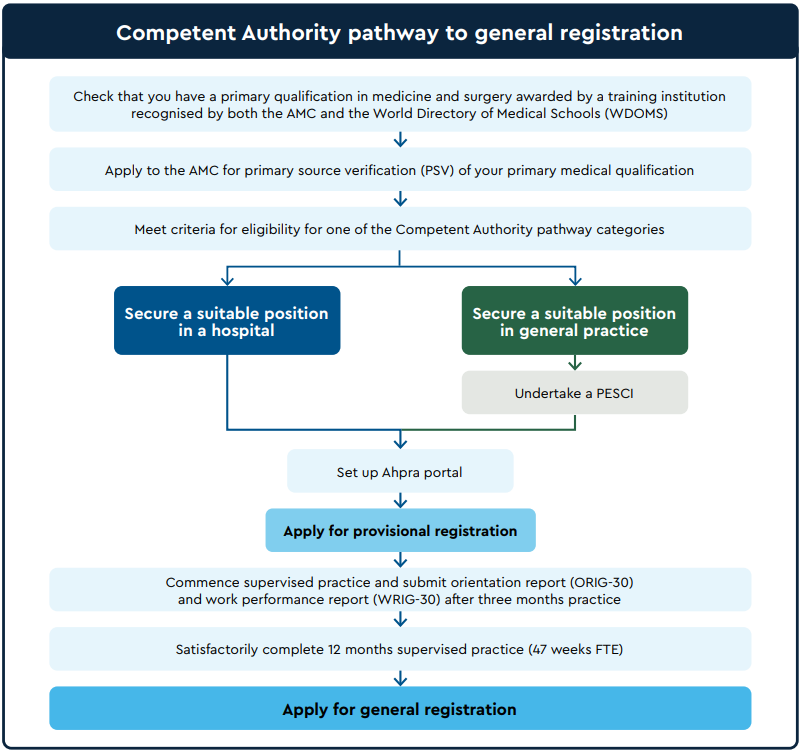
If you’d like a detailed breakdown of fees, be sure to check out our fees blog here.
How do I start this pathway?
Your first step on this pathway is to have been assessed by a competent authority and have worked for a minimum of one year (or 2 years for the US).
Aside from (1) having a primary qualification in medicine and surgery awarded by a training institution recognised by both the AMC and WDOMS, and (2) meeting the English Language Standard or passing an approved English Language Test, you are eligible for the Competent Authority pathway if you also have successfully finished one of the following:
- Category A: PLAB from the UK (since 1975), plus Foundation Year 1 or 12 months supervised Internship in the UK
- Category B: UK medical program approved by the GMC, plus Foundation Year 1 or 12 months supervised Internship in the UK
- Category C: LMCC from Canada
- LMCC – MCCQE I and II (between 1992 and October 2019), plus 12 months postgraduate education or residency training
- LMCC – MCCQE I (since November 2019), plus 12 months postgraduate education or residency training and:
- graduated from an accredited Canadian medical school, OR
- have successfully completed the National Assessment Collaboration (NAC) examination
- Category D: ECFMG from the USA
- USMLE Step 1, Step 2, and Step 3 (since 1992), plus 2 years graduate medical education within a residency program, OR
- NBME Licensing exams Part I, II, and III (before 1992), plus 2 years graduate medical education within a residency program
- Category E: NZREX from NZ, plus internship
- Category F: Ireland basic medical education program and training approved by the MCI, plus internship
- Category G: NBOME from the USA: COMLEX-USA Level 1, Level 2-Cognitive Evaluation, Level 2-Performance Evaluation and Level 3 (from 2005), plus 2 years graduate medical education within a residency program
To be eligible for the competent authority pathway, you’ll need to have a qualification (Category B and F) or assessment (Category A, C, D, E, G) component AND the prescribed post-examination or post-training experience.
The internships must be in the country, or have been recognised by the country as equivalent. Please note that experience in another competent authority country, including Australian clinical experience, can also be substituted for the post-examination or post-training experience eligibility requirement.
Please note that you do not apply for Limited Registration under the Competent Authority Pathway—you will apply for Provisional Registration.
What are the Eligible Offshore Courses?
If you took an eligible offshore course provided by the UK General Medical Council (GMC) or Ireland Medical Council of Ireland (MCI) where you studied in a different country, you still can go through the Competent Authority pathway as long as you successfully completed any of the following:
Category B: UK General Medical Council
- Newcastle University Medicine Malaysia (NUMed)
- Country: Malaysia
- Qualification: Bachelor of Medicine, Bachelor of Surgery (MBBS)
- Conferring university: Newcastle University
- Duration: 5 years
- University of Southampton
- Program name: Kassel School of Medicine BM (EU) Europe Medicine Programme
- Country: United Kingdom and Germany
- Qualification: Bachelor of Medicine, Bachelor of Surgery (BMBS)
- Duration: 5 years
- Queen Mary University of London, Barts and the London School of Medicine Malta
- Program name: Medicine MBBS Malta (Note: course commenced 2017)
- Country: Malta
- Qualification: Bachelor of Medicine, Bachelor of Surgery (MBBS)
- Conferring university: Queen Mary University of London (Barts and The London School of Medicine and Dentistry)
- Duration: 5 years
- St George’s University of London/University of Nicosia Medical School (Note: university name change from 2024 – City St George’s, University of London/ University of Nicosia Medical School)
- Program name: St George’s 4-Year MBBS Program at University of Nicosia (note – this course had last intake in 2021 and is in teach out phase)
- Country: Cyprus
- Qualification: Bachelor of Medicine, Bachelor of Surgery (MBBS)
- Conferring university: St George’s University of London (Note: university name change from 2024 – City St George’s, University of London/ University of Nicosia Medical School)
- Duration: 4 years
- St George’s University of London
- Program name: International Medicine (6-year) BSc/MBBS (Note: this course is no longer offered)
- Country: UK & USA
- Qualification: Bachelor of Science (BSc); Bachelor of Medicine, Bachelor of Surgery (MBBS)
- Conferring university: St George’s University of London
- Duration: 6 years
- St George’s University of London
- Program name: International Graduate Medicine (4-year) MBBS (Note: this course is no longer offered)
- Country: UK & USA
- Qualification: Bachelor of Medicine, Bachelor of Surgery (MBBS)
- Conferring university: St George’s University of London
- Duration: 4 years
Category F: Ireland Medical Council of Ireland
- Royal College of Surgeons in Ireland and University College Dublin Malaysia Campus (formerly Penang Medical College)
- Country: Ireland & Malaysia
- Qualification: Bachelor of Medicine, Bachelor of Surgery, Bachelor of the Art of Obstetrics (MB, BCh, BAO)
- Conferring university: National University of Ireland
- Duration: 5 years
- Royal College of Surgeons in Ireland Medical University of Bahrain
- Country: Bahrain
- Qualification: Bachelor of Medicine, Bachelor of Surgery, Bachelor of the Art of Obstetrics (MB, BCh, BAO)
- Conferring university: National University of Ireland
- Duration: 5 years
- Perdana University Royal College of Surgeons in Ireland (Note: this course is no longer offered, 2024 graduates are the last graduates with a NUI qualification)
- Country: Malaysia
- Qualification: Bachelor of Medicine, Bachelor of Surgery, Bachelor of the Art of Obstetrics (MB, BCh, BAO)
- Conferring university: National University of Ireland
- Duration: 5 years
Can experience be substituted?
Experience in one of the Competent Authority countries can be substituted for the post-examination or post-training experience requirement to meet the eligibility criteria for the Competent Authority Pathway. However, the amount of experience must be completed as defined in the original category and must be approved by the competent authority of the country.
For example, an IMG can pass the LMCC and complete 12 months of supervised training in the UK. They will be eligible for the Competent Authority Pathway since their experience component is approved by the General Medical Council.
Additionally, Australian clinical experience can be substituted for the post-examination or post-training experience requirement to be eligible for the Competent Authority Pathway.
How do I find a GP job?
If you want to find a job in General Practice, the first thing to do before looking for any General Practice positions is to check your restrictions. There are 2 for international medical graduates in the Competent Authority Pathway—19AA and 19AB:
- 19AA restricts Australian Citizens and Permanent Residents who are not Fellowed and requires them to join a 3GA training program whilst preparing for Fellowship in order to be able to access Medicare. Generally, these programs require you to work in a MM 2 – 7 area.
- 19AB restricts International Medical Graduates and requires them to work in a Distribution Priority Area for a moratorium of 10 years in order to access Medicare Benefits. You can check the DPA in the Health Workforce Locator here.
You can find General Practice positions on private or job boards, or contact us for help finding a job!
Do I need a PESCI?
If you have a job in general practice, you will be required to sit a Pre-Employment Structured Clinical Interview (PESCI) for that location. A PESCI is an interview format exam that assesses your ability to practice safely in that location. You can sit a PESCI with ACRRM, IME, or RACGP.
When you have passed your PESCI, you can now apply for Registration with AHPRA. If you require any help with this paperwork, get in touch with us!
What medical registration can I apply for?
As an IMG, you will be eligible for Provisional AHPRA Registration under the Competent Authority Pathway.
Do I need supervision?
As a doctor on Provisional Registration, you will be required to undertake 12 months of supervised practice (minimum of 47 weeks of full-time equivalent (FTE) practice). After you have completed this, you will be able to apply for General AHPRA Registration. Once granted, you will no longer require supervision. You can read more about supervision here.
How do I attain Fellowship?
In order to become a Fellowed General Practitioner, you will need to sit for either the ACRRM or RACGP Fellowship Exams. You may also be required to join a Fellowship Training Program in order to prepare for these Exams. Once you have passed, you will be a Vocationally Registered General Practitioner in Australia.
Please keep in mind that you will continue to be restricted by 19AB until the end of your moratorium.
We Can Help You
Here at People Medical Consulting, we have a passion for guiding medical practitioners through their career pathways to Australia. We have extensive experience in assisting medical facilities in recruiting doctors from local and overseas who will best suit their requirements.
We provide Document Assistance for those requiring support for their PESCI with IME, ACRRM or RACGP, registration and all other mandatory AHPRA requirements, fellowship program related forms and letters, application for Medicare provider and prescriber numbers, application for 19AB or 19AA exemptions and preparation of employment documents.
If you want to talk to someone about your pathway or practice management—book a consultation with us below, or if you need Recruitment or Document Assistance, contact us at help@peoplemedical.com.au or click the buttons below. We’d be glad to help you!
Information from this blog has been taken directly from:
- Competent Authority pathway – 22/01/2026 – 3 February 2026
- International medical graduates in the competent authority pathway – 21/03/2025 – 3 February 2026
- Medical Board – Requirements for eligibility for competent authority pathway – updated October 2024 (What are the eligibility criteria categories?) – 2/11/2025 – 3 February 2026
- Eligible offshore courses (What are the eligible offshore courses for categories B and F?) – 5/16/25 – 3 February 2026
Related Blogs


